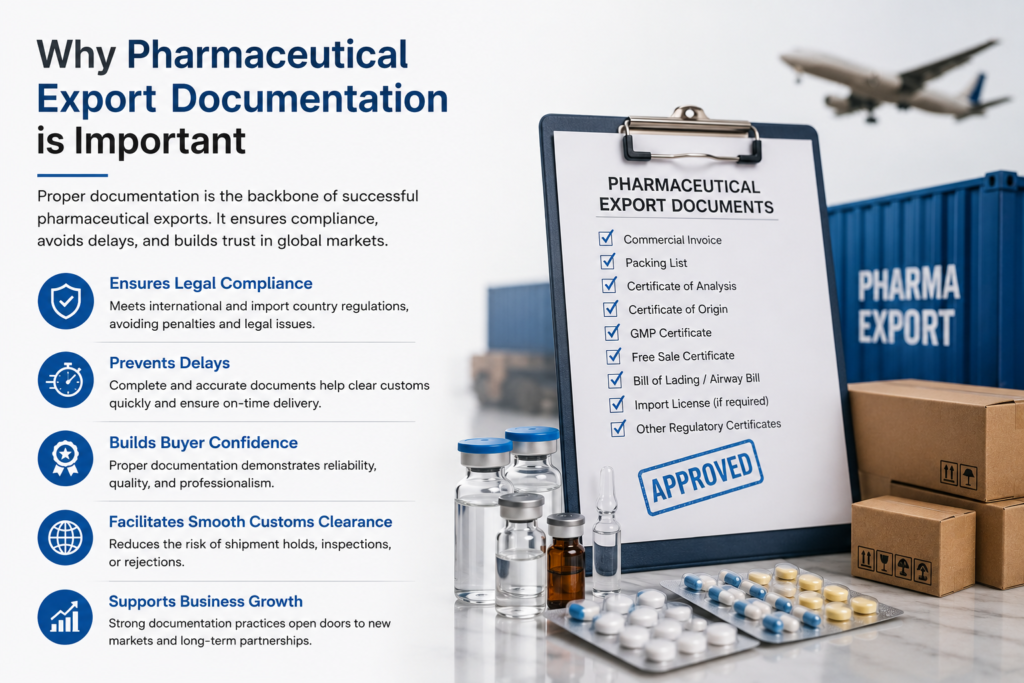
Why Pharmaceutical Export Documentation is Important
Introduction
The pharmaceutical export industry is one of the most regulated sectors in global trade. Unlike many other products, pharmaceutical goods directly impact patient health and safety, making regulatory compliance and documentation critically important.
India is one of the world’s largest pharmaceutical exporters, supplying high-quality medicines, vaccines, Active Pharmaceutical Ingredients (APIs), nutraceuticals, and healthcare products to more than 200 countries worldwide. However, successful pharmaceutical exports depend not only on manufacturing quality but also on accurate and complete documentation.
Even a minor documentation error can result in:
Shipment delays
Customs clearance issues
Regulatory penalties
Product rejection
Financial losses
Supply chain disruptions
Therefore, pharmaceutical exporters, distributors, manufacturers, and importers must understand the documentation requirements involved in international pharmaceutical trade.
Whether exporting generic medicines to Africa, supplying APIs to Europe, shipping nutraceuticals to the Middle East, or delivering specialty pharmaceutical products to Latin America, proper documentation ensures smooth transportation, customs clearance, regulatory approval, and product acceptance.
This comprehensive guide provides a complete pharmaceutical export documentation checklist, explaining the purpose, importance, and requirements of each document needed for successful pharmaceutical exports from India.
Why Pharmaceutical Export Documentation is Important
Documentation serves as the foundation of pharmaceutical international trade.
Proper documentation helps ensure:
Regulatory compliance
Product traceability
Quality assurance
Customs clearance
Buyer confidence
Legal protection
Without proper documents, even high-quality pharmaceutical products may face import restrictions.
Understanding Pharmaceutical Export Compliance
Every country has specific pharmaceutical regulations.
Regulatory authorities require documentation to verify:
Product quality
Manufacturing standards
Product safety
Legal compliance
Product origin
Exporters must comply with both Indian export regulations and destination-country requirements.
Categories of Pharmaceutical Export Documents
Pharmaceutical export documents generally fall into five categories:
Commercial Documents
Regulatory Documents
Quality Assurance Documents
Shipping Documents
Country-Specific Documents
Understanding each category helps exporters avoid compliance issues.
Commercial Documents
Commercial documents facilitate international trade transactions.
1. Commercial Invoice
The Commercial Invoice is one of the most important export documents.
It serves as:
Proof of sale
Payment reference
Customs valuation document
The invoice typically contains:
Exporter details
Importer details
Product descriptions
Product quantities
Unit prices
Total value
Currency
Terms of sale
Customs authorities use this document to calculate duties and taxes.
Importance of Commercial Invoice
A properly prepared commercial invoice helps:
Facilitate customs clearance
Avoid valuation disputes
Support payment processing
Errors can cause shipment delays.
2. Packing List
The Packing List provides detailed information about shipment contents.
Information includes:
Number of packages
Packaging type
Product quantities
Gross weight
Net weight
Dimensions
Customs officials use this document during inspections.
Benefits of Packing Lists
Packing lists help:
Verify shipment contents
Simplify customs procedures
Support warehouse operations
Regulatory Documents
Regulatory documents demonstrate compliance with pharmaceutical standards.
3. Certificate of Pharmaceutical Product (CPP)
The Certificate of Pharmaceutical Product is one of the most important pharmaceutical export documents.
It confirms:
Product approval status
Manufacturing authorization
Regulatory compliance
Many countries require CPPs during product registration.
Why CPP is Important
The CPP provides assurance that:
The product is legally manufactured
The product is approved for sale
The manufacturer complies with regulations
CPP requirements vary by country.
4. Free Sale Certificate (FSC)
A Free Sale Certificate confirms that a pharmaceutical product is legally sold in its country of origin.
The certificate demonstrates:
Market authorization
Regulatory approval
Product legitimacy
Many importing countries request FSCs during registration.
5. Manufacturing License
A manufacturing license verifies that the pharmaceutical company is authorized to manufacture medicines.
Importers often request this document to confirm legitimacy.
6. WHO-GMP Certificate
WHO-GMP certification demonstrates compliance with World Health Organization Good Manufacturing Practices.
Benefits include:
Improved regulatory acceptance
Buyer confidence
Global market access
Many countries prefer products manufactured in WHO-GMP-certified facilities.
7. Product Registration Documents
Some countries require:
Product dossiers
Registration certificates
Technical files
These documents support market authorization processes.
Quality Assurance Documents
Quality assurance documents verify product safety and compliance.
8. Certificate of Analysis (COA)
The Certificate of Analysis confirms product quality.
It includes:
Test results
Specifications
Batch information
Quality approval status
Each batch should have a corresponding COA.
Importance of COA
COAs help buyers verify:
Product identity
Product purity
Compliance with specifications
COAs are often mandatory.
9. Batch Manufacturing Record (BMR)
A Batch Manufacturing Record documents production activities for a specific batch.
Information includes:
Raw materials used
Manufacturing processes
Production dates
Quality checks
BMRs support traceability.
10. Stability Data
Stability studies demonstrate product shelf life.
Data helps regulators determine:
Storage requirements
Expiration dates
Product stability
Many countries require stability documentation.
Shipping Documents
Shipping documents facilitate transportation and customs procedures.
11. Bill of Lading (B/L)
The Bill of Lading serves as:
Transport contract
Receipt of goods
Ownership document
It is commonly used for sea freight shipments.
Types of Bills of Lading
Common types include:
Straight Bill of Lading
Negotiable Bill of Lading
Ocean Bill of Lading
12. Air Waybill (AWB)
An Air Waybill is used for air freight shipments.
It contains:
Shipment details
Consignee information
Routing information
Unlike a Bill of Lading, it is not a title document.
13. Shipping Bill
The Shipping Bill is required by Indian customs authorities for exports.
It provides information regarding:
Exporter
Products
Destination
Shipment value
Customs clearance cannot proceed without it.
14. Insurance Certificate
An Insurance Certificate protects shipments against:
Damage
Theft
Loss
Insurance is highly recommended for pharmaceutical exports.
Country-Specific Documents
Certain countries require additional documentation.
15. Certificate of Origin (COO)
The Certificate of Origin confirms the country where products were manufactured.
It may influence:
Import duties
Trade agreements
Customs procedures
16. Legalized Documents
Some countries require documents to be:
Notarized
Legalized
Apostilled
Requirements vary by jurisdiction.
17. Import Permits
Certain pharmaceutical products require destination-country import permits.
Examples include:
Controlled substances
Specialty medicines
Exporters must verify requirements before shipping.
Additional Documents Often Required
Depending on product type and destination, buyers may request:
Product brochures
Safety Data Sheets (SDS)
Product specifications
Validation reports
Packaging artwork approvals
Providing these documents improves buyer confidence.
Pharmaceutical Export Documentation Process
Understanding the export workflow helps ensure accuracy.
Step 1: Product Registration
Obtain regulatory approvals if required.
Step 2: Manufacturing
Produce products according to approved specifications.
Step 3: Quality Testing
Conduct laboratory testing and generate COAs.
Step 4: Documentation Preparation
Compile all required documents.
Step 5: Customs Clearance
Submit export documentation to customs authorities.
Step 6: Shipping
Arrange transportation and provide shipping documents.
Common Documentation Mistakes to Avoid
Many export delays result from avoidable mistakes.
Incorrect Product Information
Ensure consistency across all documents.
Expired Certificates
Verify certificate validity before shipment.
Missing Signatures
Many documents require authorized signatures.
Incomplete Documentation
Missing documents often delay customs clearance.
Incorrect Batch Details
Batch numbers should match across all records.
Best Practices for Pharmaceutical Export Documentation
Maintain Organized Records
Implement document management systems.
Regularly Update Certifications
Monitor expiration dates and renew certificates promptly.
Verify Country Requirements
Documentation requirements differ by country.
Conduct Internal Reviews
Review all documents before shipment.
Train Export Teams
Ensure staff understand pharmaceutical export regulations.
Role of Documentation in Building Buyer Trust
Accurate documentation demonstrates professionalism and reliability.
Benefits include:
Faster approvals
Stronger partnerships
Better reputation
Reduced disputes
Many buyers evaluate suppliers based on documentation quality.
Future Trends in Pharmaceutical Export Documentation
The pharmaceutical industry is increasingly adopting digital solutions.
Emerging trends include:
Electronic documentation
Digital signatures
Blockchain traceability
Automated compliance systems
These technologies improve efficiency and reduce errors.
Frequently Asked Questions (FAQs)
What is the most important pharmaceutical export document?
The Certificate of Pharmaceutical Product (CPP), Commercial Invoice, and Certificate of Analysis (COA) are among the most important.
Is a WHO-GMP certificate mandatory?
Requirements vary by country, but WHO-GMP certification is widely preferred.
What is a Certificate of Analysis?
A document confirming product quality and compliance with specifications.
Why is a Free Sale Certificate required?
It confirms that products are legally sold in the country of origin.
What is the purpose of a Commercial Invoice?
It serves as proof of sale and supports customs valuation.
What shipping documents are required?
Bill of Lading or Air Waybill, Shipping Bill, and Insurance Certificate.
Do all countries require the same documents?
No. Requirements vary by country and product category.
What is a Certificate of Origin?
It identifies the country where products were manufactured.
Can documentation errors delay shipments?
Yes. Even minor errors can result in customs delays and regulatory issues.
Why is documentation important in pharmaceutical exports?
It ensures compliance, quality assurance, traceability, and smooth customs clearance.
Conclusion
Pharmaceutical export documentation is a critical component of successful international pharmaceutical trade. Accurate and complete documentation ensures regulatory compliance, customs clearance, product traceability, quality assurance, and buyer confidence.
For pharmaceutical exporters, maintaining a comprehensive documentation system helps reduce risks, improve operational efficiency, and strengthen global business relationships. From Commercial Invoices and Certificates of Analysis to WHO-GMP certificates and CPPs, every document plays an essential role in supporting international pharmaceutical exports.
As pharmaceutical trade continues to expand globally, exporters that prioritize documentation accuracy and compliance will be better positioned to achieve sustainable growth and long-term success in international markets.
Target Keywords
Primary Keyword
Pharmaceutical Export Documentation Checklist
Secondary Keywords
Pharmaceutical Export Documents
Pharma Export Documentation
Medicine Export Documentation
Pharmaceutical Export from India
Certificate of Pharmaceutical Product
WHO GMP Certificate
Pharmaceutical Export Compliance
Pharmaceutical Shipping Documents
Pharma Export Process
Pharmaceutical Registration Documents
LSI Keywords
Pharmaceutical Export Procedures
Export Documentation for Medicines
Pharma Regulatory Compliance
Pharmaceutical Customs Clearance
Export Certificates for Pharmaceuticals
International Pharma Trade
Pharmaceutical Quality Documents
Global Pharma Export
Word Count: Approximately 3,700+ Words
SEO Intent: Informational + Commercial + Export Compliance
Recommended Internal Links:
Pharmaceutical Export from India to Worldwide Markets
WHO-GMP Certified Pharmaceutical Manufacturers in India
How to Choose a Reliable Pharmaceutical Export Company in India
Exporting Pharmaceutical Products to Africa
Top Pharmaceutical Products Exported from India

